


Technical configurator
Chemical resistance
Select up to 10 media and the materials you want to compare. The results show the expert data available for each temperature.
How can you find a suitable material for aggressive chemicals?
Over more than 20 years in the industry, we have gained extensive experience and knowledge that we can share with you and use to provide the necessary information about the chemical compatibility of plastic materials.
Not every plastic piping material is suitable for transporting aggressive liquids and gases. Using the wrong materials can therefore cause complications. Our online tool now lets you quickly and easily find the right materials for your application.
The tool also includes a recommended welding/bonding method and helps you select a suitable seal.
- Select the medium you want to transport.
- Our online tool will then show suitable materials in a clear table.
The displayed values apply to the specified conditions, assuming continuous exposure to the medium at the stated temperature and use in a pressurised piping system. Under specific operating conditions (such as temporary contact with the medium, an unpressurised drainage system or a short-term temperature increase), an originally negative suitability rating may be reassessed. Please contact us for more information.
Disclaimer
Notice!
We would like to emphasize that no warranty or liability claims can be derived from our information. We accept no liability for damages of any kind that may result from the use of this data. This publication is intended solely to provide technical information.
1. Select chemicals
0 of 10
2. Select materials
Selected: 15
3. Compatibility results
Each cell belongs to one chemical, material, and temperature.
Start by selecting a chemical
After adding a chemical and at least one material, the technical comparison will appear here.
Technical explanations
General information regarding chemical resistance
De-rating factor
The Georg Fischer Piping Systems pressure/temperature diagrams are based upon a life expectancy of 25 years. They are valid for water and certain aqueous solutions which do not impact the plastic material properties. However, several aggressive chemical media may affect the plastic and could impact the lifetime of the system or operating parameters. A de-rating factor reduces the maximum pressure for a plastic/medium combination in order to maintain the material performance. De-rating factors are > 1 (typically in the range of 1–1.3; a few are higher). To use the de-rating factor, divide the maximum rated pressure by it to obtain the maximum sustainable pressure of the system, or multiply the pressure by it to obtain the maximum operating temperature.
Example: An aqueous medium in a polyethylene piping system (SDR 11) allows a maximum pressure of 9 bar (132 psi) at a temperature of 40 °C for a 25-year lifetime (see PT diagram: point A).
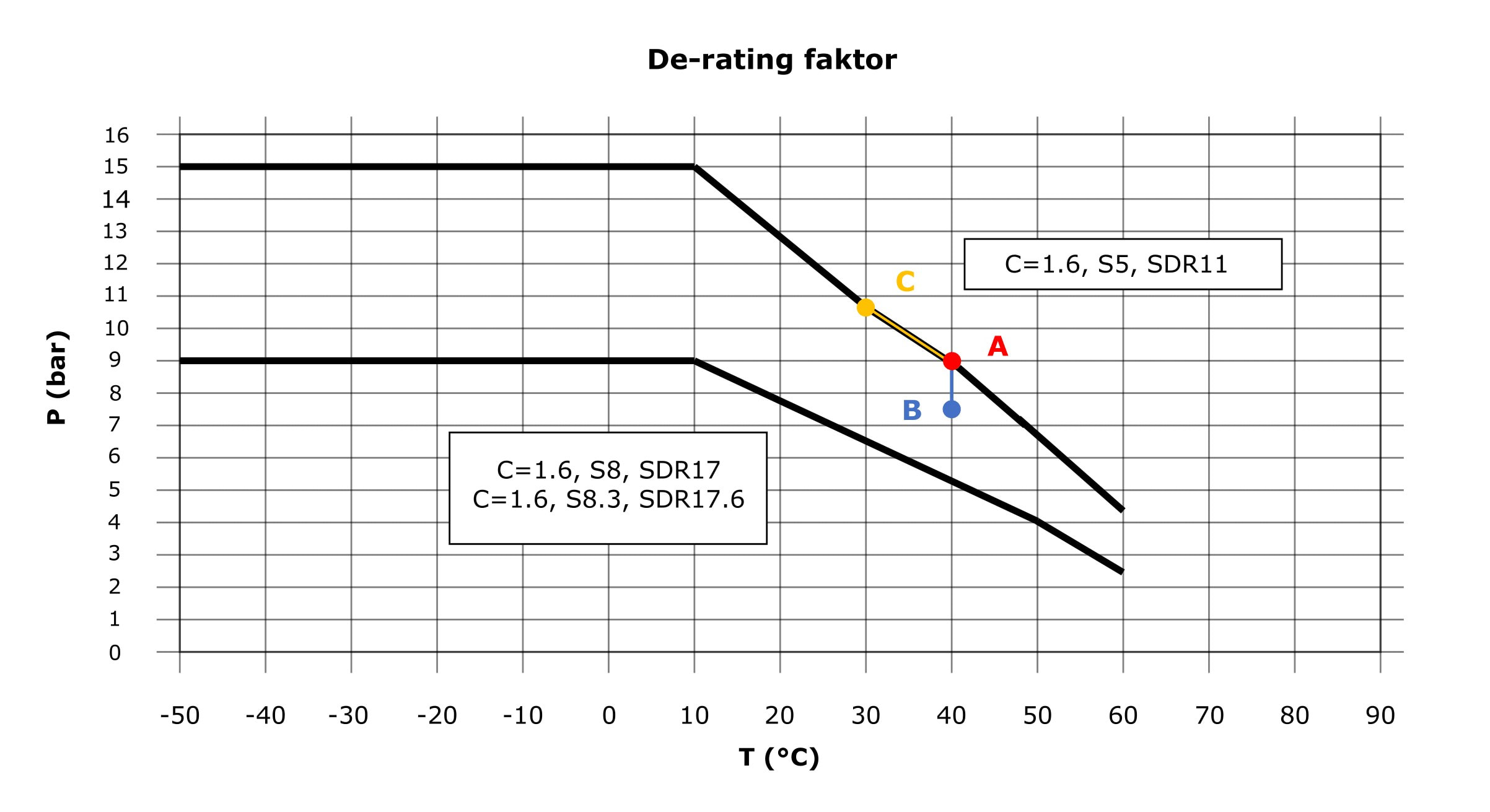
Hydrochloric acid 37% in polyethylene has a de-rating factor of 1.2. The maximum pressure of that system at a temperature of 40 °C is 9 bar / 1.2 = 7.5 bar (110 psi), point B on the graph. Additionally, if the system is operated at 9 bar, the de-rating factor times operating pressure (9 × 1.2 = 10.8 bar) corresponds to 30 °C, or point C on the graph, which represents the maximum operating temperature of the system at 9 bar. For further explanation, please contact PPS Engineering CZ.
Solvent cement joints with Tangit and DTX
ABS, PVC-U and PVC-C are typically cemented with Tangit. However, some aggressive media at higher concentrations require Tangit DTX as a chemically more resistant cement. The use of DTX brings about some restrictions: a de-rating factor, an upper temperature limit of 60 °C and a lifetime limitation.
The following chemicals and concentrations require Tangit DTX:
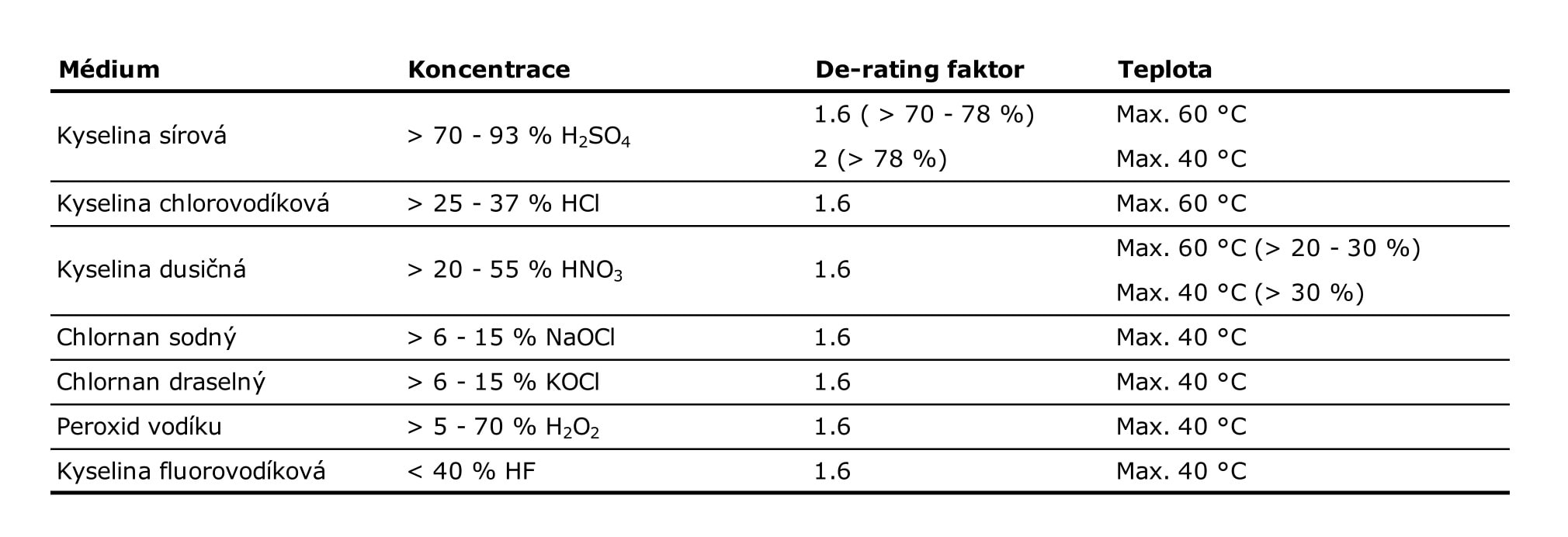
The quality and chemical resistance of a DTX joint depend upon proper processing. Please contact PPS Engineering CZ for further details.
Flammable liquids
Besides questions of chemical resistance, multiple organic media demand particular safety considerations due to their flammability and combustion properties. The database recommendations refer exclusively to chemical resistance considerations. They do not replace technical installation guidelines or restrictions. These guidelines are typically defined by legislation and standards such as ATEX, ASME, ASTM and NFPA. Some guiding principles are listed in the chapter “Plastic pipelines in highly combustible locations / Transport of explosive media” within the GF Planning Fundamentals. Ultimate compliance with these guidelines, however, must be ensured by the ordering party or the construction company.
Gaskets
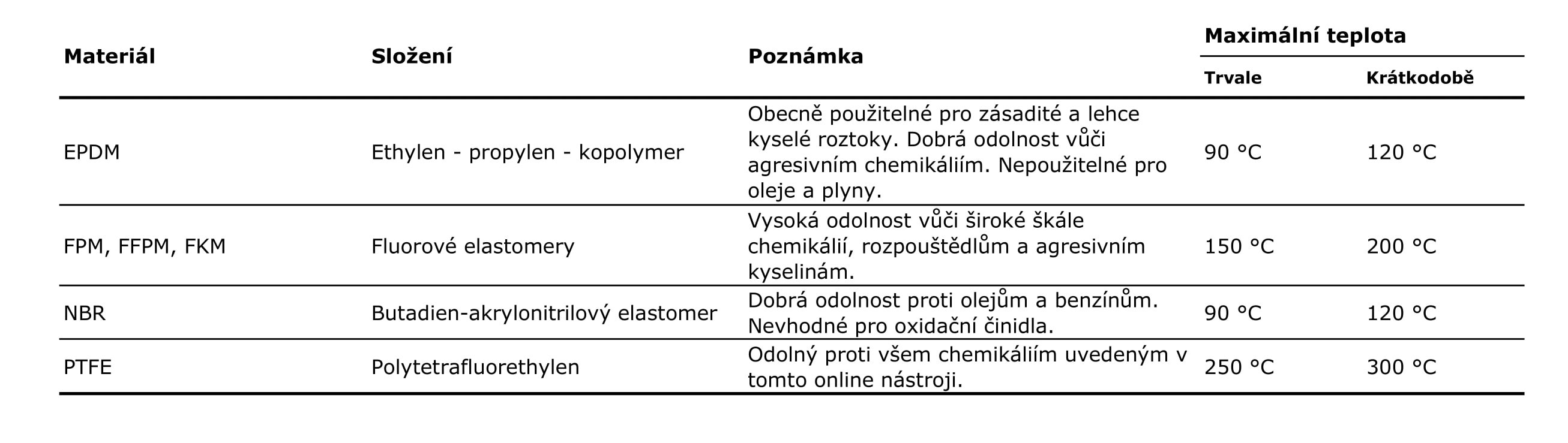
Sealing materials are an essential part of the entire piping system. The choice of the gasket material depends not only on chemical resistance aspects but also on mechanical considerations. Even though a recommendation should always be made on an individual case-by-case basis, some general rules apply to our standard gasket materials:
Disclaimer
The data are provided as is and there is no warranty or representation, either express or implied, that they are free from errors. We shall not be liable for damages of any kind that may result from the use of this data.
The successful operation of valves does not depend only on the chemical resistance of their materials and seals; a number of additional factors must be considered. Therefore, these data cannot be transferred without restriction to the operation of valves made from the same materials and/or combinations of materials.
This document serves only to provide technical information. We refer to our General Sales Terms. Subject to change without notice.
Share configuration
The current chemicals, materials, and search are part of the URL. You can copy or bookmark it without saving anything to the database.